

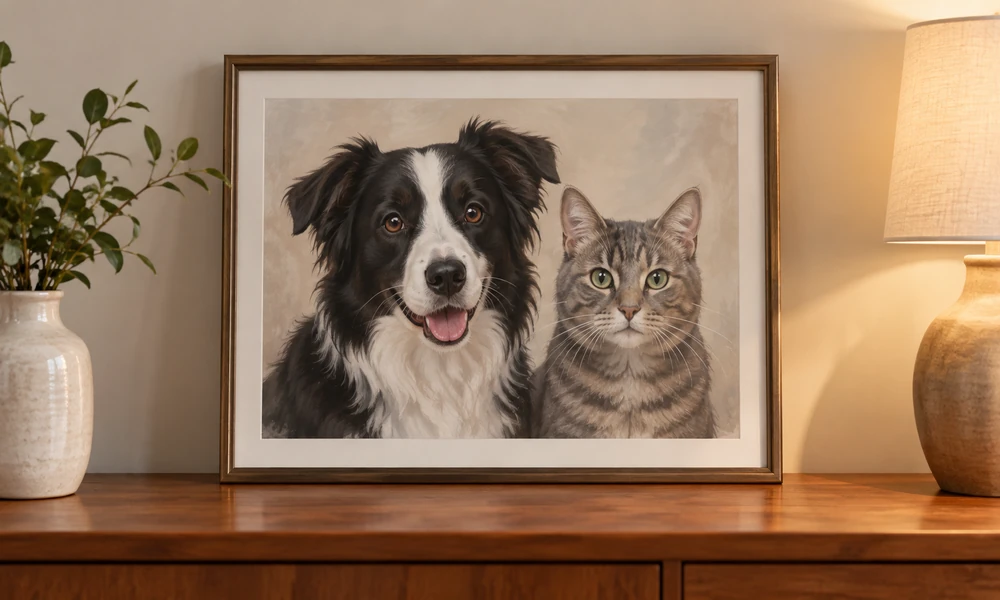
One pet is always in front of the camera. The other waits a few feet away. When both belong in the same pet portrait, simply making their heads the same size may not produce the picture you want. A lively dog and a quiet cat can share a composition without being made to look identical in attitude or importance.
Planning a custom pet portrait for two animals is partly a question of relationship. Do you want the pair to feel like companions, individual characters, or two familiar faces with equal attention? Decide that before debating small decorative details. The arrangement should make space for the difference between them.
Describe the relationship without assigning a story they do not show
Begin with what you actually know about the animals. They may rest in the same room, follow different family members, or spend little time close together. A portrait can include them both without pretending that they routinely cuddle.
Write a few plain observations. Perhaps the dog usually looks outward while the cat watches from the side. Perhaps both have a familiar upright resting pose. These notes can explain the mood you want without turning behavior into a fictional account of friendship or rivalry.
Then decide what the portrait should emphasize. A paired arrangement can show two individuals who belong to one household. It does not need a scene of interaction to communicate that connection. If you want them facing toward each other, ask whether the selected design supports it rather than assuming every pose can be changed.
If several family members are choosing the artwork, discuss the relationship first. That helps prevent one person from requesting a playful scene while another expects a calm formal pair.
Decide what equal attention means in this picture
Equal attention is not necessarily identical height, head size, or pose. A larger dog and a smaller cat have different real proportions. You may want the composition to retain that difference while still giving each face a clear place.
Look at the image as a whole. Does one animal immediately draw your eye because of a brighter color, a larger face, or more decorative detail? That may be intentional, but it should not happen merely because one reference image was more prominent.
Identify the visual priority you want. Both faces might deserve similar clarity even if the bodies differ in scale. Another family might prefer one pet slightly forward because the source pose supports it. There is no need to turn that choice into a judgment about which animal matters more.
Be explicit about your concern when writing the brief. “We would like both faces to remain easy to see” provides useful direction. “Make them completely equal” leaves the portrait maker to guess which parts should match.
Choose an arrangement the selected design can support
Different portrait products have different composition limits. Some use a set arrangement, while others permit more changes. Before planning a complex scene, check the actual two-pet option and ask about any essential request that is not shown.
You might prefer side-by-side faces with separate space around each. A staggered arrangement can give a taller and shorter animal different positions. A quiet background can help both remain readable without adding symbols around every pet.
These are possibilities to evaluate, not promises about a provider’s customization service. If a particular gaze direction or body pose is essential, confirm feasibility before ordering. Avoid basing the entire commission on an adjustment the product does not offer.
For a specific physical option, Pawfolio Art’s two-pet Art Print is a relevant place to check the available selections. Keep that format-qualified choice separate from the broader idea of a portrait, which can be presented in different ways.
Preserve each animal’s distinguishing details
Make a short reference note for each pet rather than one combined description. Identify the main image, the name if it is being included, and the features that should remain visible. This reduces the risk of a marking or instruction being applied to the wrong animal.
A black-and-white dog might need an uneven facial patch preserved. A tabby cat might be recognizable through a particular muzzle shape or ear position. Focus on the details that matter to your family instead of listing every feature in the photograph.
Check whether the references represent the same intended period. If one image shows a puppy and the other a current adult pet, decide whether that contrast is deliberate. Do not leave the artwork maker to infer that both should appear as they do today.
Pet portraits from photos depend on the information supplied, but the task here is not to make both references look alike. Different expressions can belong in the same picture. The identifying details should remain clear even when the surrounding style gives the artwork a shared visual treatment.
Review the pair before reviewing the small details
When a proof is included, begin at a size where you can see the complete composition. Check whether both animals have room and whether the arrangement feels like the relationship you described. Then enlarge the faces for a likeness review.
Consider the space between the animals. An accidental overlap can hide an ear or make a body edge hard to read. Excess empty space can make a pair feel disconnected when you wanted them close. Ask about a specific adjustment only if it supports the intended composition.
Combine revision notes into one message. Separate the overall request from the pet-specific corrections, and label the animals clearly. A short numbered list can be useful here because the instructions concern distinct parts of one image.
If you are still comparing providers or formats, paired and individual portrait options at Pawfolio Art can help you decide where to start. Confirm the selected product’s pet count and other options rather than assuming every design shown on a homepage accommodates the same arrangement.
Keep the finished portrait focused on the pair
Two pets already give the image a substantial subject. Names, dates, props, and extra background elements may be meaningful, but each addition should earn its space. You can preserve longer stories in an accompanying card or album.
Before final approval, ask each participating family member to identify the animals without looking at your reference notes. If the composition works but one face does not feel familiar, address that detail instead of adding more decoration around it.
Also check the selected physical size independently of the digital preview. A proof filling a laptop screen does not tell you how a finished piece will sit on a shelf or wall. Measure the intended location and verify the product selection.
A two-pet portrait can show a shared household while retaining two distinct personalities. Agree on the relationship, give both faces readable space, and keep each animal’s reference information separate. The result should feel like your particular pair rather than two interchangeable figures in one frame.
