

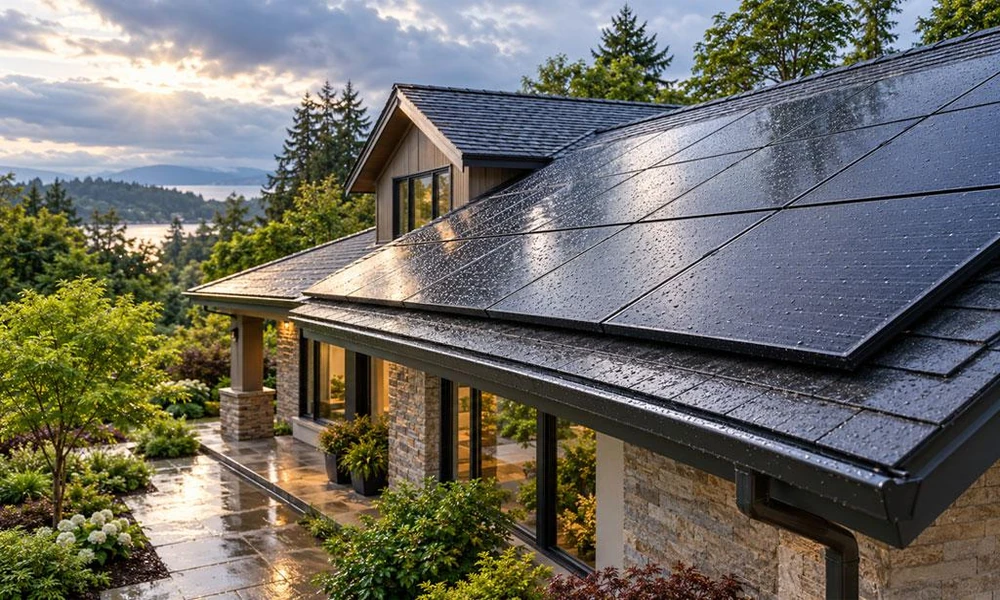
In a humid climate, exterior home improvements are routinely assessed for their response to moisture. Homeowners discuss roof drainage, window seals and the durability of outdoor finishes. Solar panels deserve a similarly detailed conversation. Their glass surface is the most visible protective feature, but the construction behind it also matters. Understanding encapsulation helps you ask how a proposed module has been designed and evaluated for its intended environment.
Describe the property before discussing specific products. Tell the installer about persistent humidity, nearby water, shaded areas and any history of drainage problems. Request an assessment of the actual roof and proposed installation location. A regional climate label is a useful starting point, but it cannot describe every exposure condition around a house. Photographs and a site visit can make the recommendation more relevant.
Within a photovoltaic module, encapsulation materials bond the internal assembly and help protect the cells. Moisture behavior depends on the whole construction, including protective surfaces, edges and material interfaces. The IEA PVPS technical guidebook on BIPV describes encapsulation as part of the protection of the photovoltaic laminate. This makes film selection worth discussing alongside the manufacturer’s approach to the rest of the module.
POE encapsulation is one option manufacturers evaluate for moisture resistance and electrical performance. B602 POE solar film is developed for high light transmission, adhesion retention and photovoltaic protection, with applications including dual-glass modules. For homeowners, it offers a concrete example of an internal material whose properties can contribute to module design. Its datasheet describes the film; evidence for the completed panel should come from the panel supplier.
EPE films provide a different material arrangement through a co-extruded multilayer structure. B602M EPE solar film combines optical and protective properties with manufacturing compatibility. A manufacturer may consider this balance when selecting an encapsulation system. When comparing an EPE-based panel with a POE-based alternative, request information about the actual assemblies and their testing rather than treating the material names as a universal ranking.
Test reports become more useful when their context is clear. Ask which module model was evaluated, whether the tested construction matches the proposed product, and what changes occurred during testing. Request an explanation of damp-heat, adhesion and insulation results in language you can follow. A supplier should be able to distinguish measured test outcomes from projections about decades of operation on a particular property.
Material combinations also deserve attention. The IEA PVPS report on newer photovoltaic technologies emphasizes the importance of formulation and compatibility when evaluating encapsulation durability. Ask how the manufacturer controls its approved material combinations and handles substitutions. Keeping the quoted module model and revision recorded can help ensure that the product discussed during selection is the one delivered.
Consider the roof and installation details at the same time. Ask the designer to explain the mounting arrangement, cable routing and any manufacturer-specified clearances. Review how access to gutters and drainage will be retained. If the roof has existing moisture issues, include their investigation in the renovation scope. Internal encapsulation cannot resolve a building defect or an installation detail that requires separate attention.
Discuss maintenance in practical terms. Request the manufacturer’s cleaning instructions, the installer’s inspection recommendations and a clear route for reporting visible changes or operating alerts. Ask how servicing would be arranged without unnecessary access across the roof. Store the initial module photographs and commissioning records so that later observations can be compared with the installation’s original condition.
Read warranty documents with the local exposure in mind. Ask whether the supplier requires any specific maintenance records and which party would handle a concern involving appearance, electrical operation or installation workmanship. Clarify what evidence is needed for a claim and who would arrange inspection. Keeping these answers in writing makes future conversations easier for the homeowner and the service team.
Imagine comparing two panels with similar dimensions and rated output. One supplier recommends an EPE-based design; another proposes a POE-based design. Instead of asking which polymer must be better, ask both suppliers to explain their recommendation using the same headings: construction, relevant testing, local application experience and after-sales support. Request documents for the quoted models rather than a presentation covering an entire product family. If important information is unavailable, record that gap and request clarification. This keeps the purchasing decision connected to the products you can actually order, rather than to broad claims about a material category.
For the final comparison, give each shortlisted installer the same questions about module construction, environmental testing, maintenance and support. Record the answers beside the quoted model and scope of work. If a supplier recommends EPE or POE encapsulation, ask for the reason in relation to that exact product. Choose the proposal whose specification and service arrangements you can understand, verify and retain with your home’s improvement records.
