

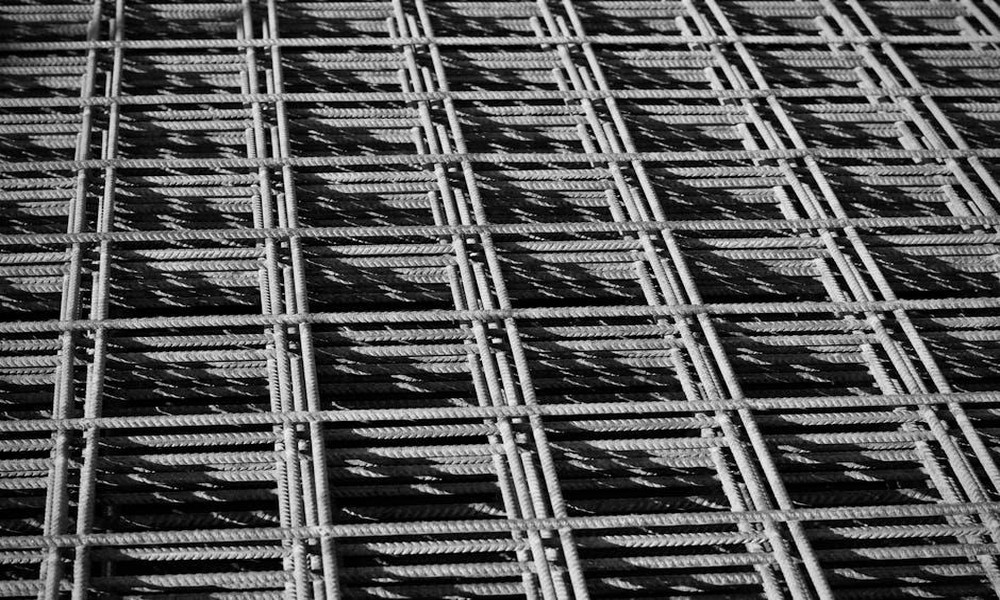
The Evolution of Concrete Construction Supports
In the dynamic world of construction, the integrity of reinforced concrete structures is paramount. From soaring high-rises to sprawling infrastructure, the durability and safety of these marvels depend on meticulous planning and execution. At the heart of this reliability lies the precise placement of steel reinforcement.
We understand that concrete, while strong in compression, relies on embedded steel rebar to handle tensile forces. For this partnership to succeed, every piece of rebar must be held firmly in its intended position during the concrete pour. This is where continuous rebar supports, such as high chairs and slab bolsters (like those offered by Hercules continuous rebar supports), become indispensable. They ensure the correct concrete cover and spacing, guaranteeing the structural performance of the entire element.
This comprehensive guide aims to shed light on the vital role of these often-overlooked components. We will explore the evolution of continuous rebar supports, their diverse types and material specifications, and the industry standards that govern their use. We will also delve into their installation techniques and how they contribute to the monolithic assembly and long-term durability of concrete elements. Reliable supports are not just accessories; they are fundamental to achieving robust and safe concrete construction in April 2026 and beyond.
Historically, maintaining the precise position of rebar within concrete elements presented a significant challenge. Early methods often relied on rudimentary techniques, such as using rocks, wood blocks, or even pieces of broken concrete to prop up reinforcement. While these approaches might have sufficed for less critical applications, they lacked consistency and often compromised the structural integrity of the finished product. The need for more reliable and standardized solutions quickly became apparent as concrete construction grew in complexity and scale.
The introduction of individual rebar chairs marked a significant step forward. These small, often wire-formed or plastic units, provided a dedicated point of support for individual rebar bars or small mats. However, for larger slabs or where multiple layers of reinforcement were required, individual chairs necessitated the use of “carrier bars.” These additional bars would span across multiple individual chairs, providing a continuous line upon which the main reinforcement could rest. This method, while effective, added complexity, increased material usage, and demanded more labor for placement. Each individual chair had to be positioned, and then the carrier bar laid and tied, before the primary reinforcement could be placed.
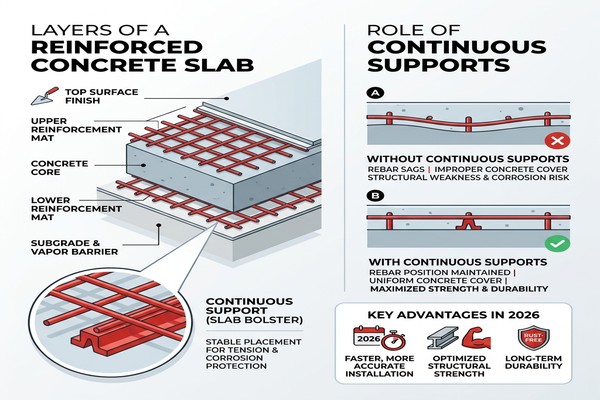
The true innovation arrived with the development of continuous rebar supports, often referred to as continuous high chairs or slab bolsters. These elongated support units offered a more efficient and reliable alternative. Their primary purpose in concrete construction is to provide a stable, continuous line of elevation for reinforcing steel, ensuring that the rebar maintains its specified height within the concrete formwork during the pouring and curing process. This continuous support eliminates the need for carrier bars entirely, streamlining the placement process and reducing the overall labor required. Instead of placing numerous individual chairs and then a secondary bar system, a continuous support can be laid directly, providing immediate and consistent elevation.
This shift has profound implications for construction efficiency and structural integrity. By ensuring consistent concrete cover-the protective layer of concrete surrounding the rebar-continuous supports help prevent corrosion of the steel, which is a leading cause of concrete deterioration. Proper spacing also guarantees that the concrete can fully encapsulate the rebar, allowing for optimal bond development and the effective transfer of stresses. As the Concrete Reinforcing Steel Institute (CRSI) emphasizes, correct placement of reinforcing bars is critical to the performance of reinforced concrete elements, underscoring the importance of reliable support systems. For more insights into best practices for rebar placement, refer to resources like the CRSI’s guide on Placing Bars.
Modern Concrete Construction Supports in High-Rise Projects
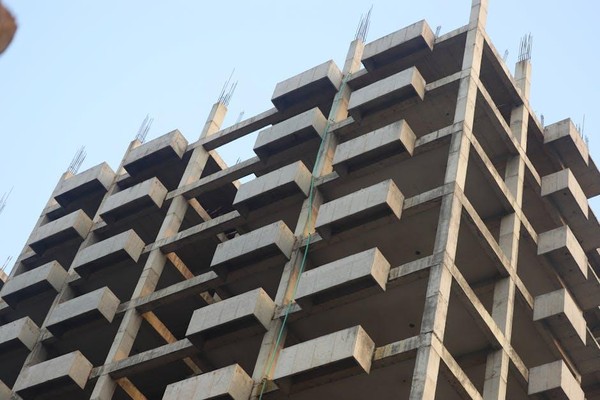
In the context of modern high-rise construction, where structural demands are immense and precision is non-negotiable, continuous rebar supports play an even more critical role. These structures often involve multi-story slabs, beams, and columns that must act as a cohesive unit to distribute immense loads and resist environmental forces.
Continuous high chairs are particularly vital for supporting upper slab steel. In many slab designs, two layers of reinforcement are specified: a bottom mat to resist positive bending moments and a top mat to resist negative bending moments. The upper layer of rebar must be elevated to a precise height to achieve its designed structural function. Continuous high chairs provide this elevation consistently across large floor plates, ensuring that the top reinforcement is perfectly positioned. This precision is crucial for maintaining structural continuity between adjacent slab sections and for effective load distribution throughout the entire floor system.
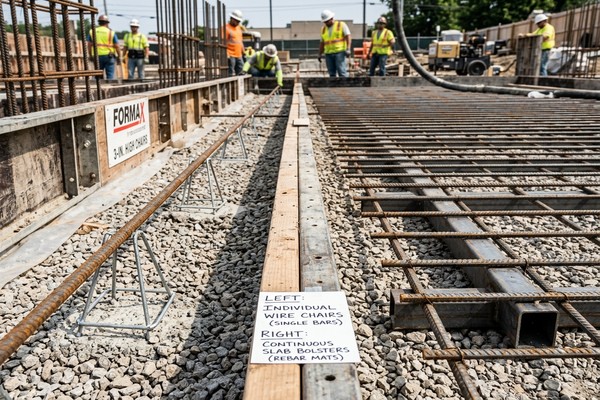
Furthermore, in high-rise buildings, construction joints are inevitable. These are planned breaks in the concrete pour that allow for phased construction. At these joints, it is essential to ensure reinforcement continuity to transfer forces across the joint effectively. While various mechanical systems exist for this purpose, the overall stability and precise alignment of the rebar leading up to and away from these joints are heavily reliant on robust continuous supports. The ability of these supports to maintain rebar position contributes directly to the monolithic assembly of the structure, even when poured in stages. Specialized reinforcement continuity systems, as detailed by manufacturers like those discussed in Reinforcement Continuity Systems, are often used in conjunction with continuous rebar supports to achieve optimal performance at these critical junctures.
Material Specifications and Continuous Support Types
The market for continuous rebar supports offers a diverse range of options, each tailored to specific project requirements, environmental conditions, and budget considerations. Understanding the different types, their material specifications, and typical dimensions is key to selecting the most appropriate support for any given concrete project.
Metal Continuous Rebar Supports: These are perhaps the most traditional and widely used type. They are typically fabricated from steel wire, bent into a continuous truss-like shape. Metal supports come in various finishes:
- Plain Finish: Uncoated steel, suitable for interior applications where corrosion is not a significant concern and where the concrete cover is sufficient to protect the steel.
- Dipped Coating: A thin protective coating applied to the steel, offering a basic level of corrosion resistance.
- Epoxy-Coated Steel: These supports are coated with a durable epoxy resin, providing excellent corrosion protection. They are often specified for projects exposed to harsh environments, such as marine structures, bridge decks, or areas prone to de-icing salts, where the prevention of rebar corrosion is paramount. Epoxy-coated metal continuous high chairs, for instance, are designed to provide continuous support for upper rebar layers in concrete structures, especially where enhanced durability is needed.
Metal continuous rebar supports are available in a wide range of cover heights, typically from 2 inches to 16 inches, in 1/2-inch increments, allowing for precise adjustment to achieve the specified concrete cover. Many continuous high chairs are manufactured in standard 5-foot lengths, which are easy to handle and install. Larger continuous supports, such as some CS Continuous Support products, can be found in 8-foot increments, often bundled in 80-foot packages. The weight of these supports can vary significantly based on height and gauge of wire; for example, a typical 8-inch metal continuous high chair upper weighs approximately 0.83 lbs per linear foot.
Plastic Continuous Rebar Supports (Slab Bolsters): An increasingly popular alternative, plastic slab bolsters offer several advantages, particularly their non-corrosive nature.
- Material: Plastic slab bolsters are commonly made from 100% virgin polypropylene. This material choice is crucial as it ensures high strength and durability, often surpassing supports made from recycled plastics. The virgin polypropylene provides a robust, non-reactive support that will not rust or stain the concrete, making them ideal for architectural concrete or projects where appearance is important.
- Design: These bolsters often feature a “snap & lock” connection system, allowing multiple units to be easily joined together to form continuous lengths. They can also be flexible enough to be bent into curves or even circles and locked onto themselves for specific applications.
- Dimensions: Plastic slab bolsters are typically manufactured in standard lengths, such as 2.5 feet (30 inches). Their heights vary, with common sizes like 1.5 inches. A plastic slab bolster measuring 2.5 feet in length and 1.5 inches in height weighs approximately 0.29 lbs per unit, making them lightweight and easy to transport and install.
Here’s a brief comparison of typical metal continuous high chairs and plastic slab bolsters:
Feature Metal Continuous High Chairs (Epoxy-Coated) Plastic Slab Bolsters (Virgin Polypropylene) Material Steel wire, epoxy-coated 100% Virgin Polypropylene Corrosion Excellent resistance due to epoxy coating Non-corrosive, no rust or staining Typical Heights 2″ to 16″ in 1/2″ increments Various standard heights (e.g., 1.5″, 2″) Typical Lengths 5-foot standard, some 8-foot increments 2.5-foot standard Weight Approx. 0.83 lbs/linear foot (8″ height) Approx. 0.29 lbs/unit (1.5″ x 2.5 ft) Key Benefit High strength, wide range of heights Lightweight, non-corrosive, easy connection Compliance CRSI standards (various classes) CRSI Class 1 Bar Support standards When selecting the right continuous rebar bolster for a specific concrete project, factors such as the required concrete cover, the environment (e.g., exposure to moisture or chemicals), the load-bearing capacity needed, and ease of installation must be considered. Products like Hercules continuous rebar supports are designed to meet these diverse needs, offering robust solutions for various applications.
Engineering Standards for Structural Integrity
The structural integrity of reinforced concrete is not merely about placing rebar; it’s about placing it precisely according to stringent engineering standards. Continuous rebar supports are instrumental in achieving this precision, and their design and application are governed by comprehensive industry codes and specifications. These standards ensure that the supports themselves are robust enough to perform their function and that their use facilitates the correct placement of reinforcement, which is fundamental to the safety and longevity of the structure.
Key organizations that establish these standards include:
- American Concrete Institute (ACI): ACI codes, particularly ACI 318 “Building Code Requirements for Structural Concrete,” provide the foundational rules for concrete design and construction. These codes specify minimum concrete cover requirements, rebar spacing, and development lengths-all of which directly influence the selection and placement of continuous rebar supports. For example, ACI specifies minimum clear spacing for reinforcement, typically the larger of one bar diameter or 1 inch, to ensure proper concrete flow and bond.
- Concrete Reinforcing Steel Institute (CRSI): CRSI is a leading authority on steel reinforcement. Their publications, such as the “Manual of Standard Practice,” offer detailed recommendations for the manufacturing, detailing, and placement of reinforcing steel and bar supports. CRSI classifies bar supports into different categories based on their strength and application. For instance, plastic slab bolsters are designed to meet CRSI Class 1 Bar Support standards, indicating their suitability for heavy-duty applications.
- ASTM International: ASTM standards define the material properties and testing methods for the steel used in rebar supports, as well as for the rebar itself. These standards ensure that the materials used in continuous supports possess the necessary strength and durability.
Continuous rebar supports directly contribute to structural integrity by:
- Ensuring Proper Concrete Cover: By elevating the rebar to the specified height, supports guarantee the minimum concrete cover, which is essential for protecting the steel from corrosion and fire.
- Maintaining Rebar Spacing: They help maintain the correct clear spacing between rebar bars, allowing concrete to flow freely around the reinforcement and achieve a strong bond. This is also critical for crack control and overall structural performance.
- Facilitating Development Length: Proper placement of rebar, aided by continuous supports, ensures that bars can achieve their required development length-the length of embedment needed to transfer stress from the rebar to the concrete. This is a critical factor in preventing pull-out failures.
- Supporting Structural Integrity Reinforcement: In elements like slabs, continuous bottom bars in column strips are often required to extend continuously for structural integrity. Continuous supports facilitate the precise placement of these long runs of reinforcement. Similarly, in perimeter beams or seismic critical members, specific reinforcement patterns and continuity are vital, and these supports help achieve the necessary alignment. Detailed provisions for such reinforcement are outlined in engineering software manuals and codes, as highlighted in resources like 2.5.Detailing-Provisions.
Compliance for Concrete Construction Supports
Compliance with these industry standards is not just a matter of best practice; it’s a legal and ethical obligation that ensures the safety and performance of concrete structures. The CRSI Manual of Standard Practice, for example, provides invaluable guidance on everything from material specifications to recommended details and placing sequences for bar supports in various concrete elements. This manual is a go-to resource for engineers and contractors to ensure their projects meet or exceed industry benchmarks.
ACI code requirements further dictate the specifics of rebar placement, including tolerances. These tolerances specify the permissible deviation from the design position of the rebar. Continuous rebar supports, by providing a stable and consistent base, significantly help in adhering to these tight tolerances, minimizing the risk of structural deficiencies.
Corrosion protection is another critical aspect addressed by these standards, especially in challenging environments. For instance, in marine environments or areas subjected to freeze-thaw cycles and de-icing salts, epoxy-coated rebar and corresponding epoxy-coated continuous supports are often mandated. These coatings provide a barrier against chlorides and other corrosive agents, extending the service life of the structure. The selection of appropriate supports is therefore directly linked to the long-term durability of the concrete element.
Understanding the principles of how reinforcement functions within concrete, particularly regarding connections and development lengths, is paramount. As discussed in academic texts like Chapter 5 – Reinforced concrete: Connections, the bond between steel and concrete, and the adequate embedment of bars, are fundamental to the structural behavior of reinforced concrete. Continuous rebar supports are the physical means by which these theoretical requirements are translated into practical, on-site reality, ensuring that the reinforcement system performs as designed.
Installation Techniques and Selection Criteria
The effective performance of continuous rebar supports hinges not only on their quality but also on proper installation and thoughtful selection. While specific techniques may vary slightly depending on the product type and project scale, several common practices ensure optimal results.
For metal continuous high chairs, installation typically involves laying them directly onto the formwork or the lower mat of reinforcement. They are then secured to the rebar using tie wire, commonly 16.5 gauge, to prevent displacement during the concrete pour. This ensures that the high chair remains stable and firmly holds the upper rebar in its designed position.
Plastic slab bolsters, on the other hand, often feature user-friendly “snap-and-lock” connection systems. This innovative design allows workers to quickly and securely join multiple bolster units together, forming continuous lines of support across large areas. This significantly speeds up installation time compared to tying individual components. Their flexibility also allows them to be bent and locked into circular or curved configurations, making them versatile for various slab shapes and designs.
When it comes to connecting or installing continuous rebar supports in a concrete project, the goal is always stability and precision. Supports should be placed at appropriate intervals to prevent sagging of the rebar. For larger projects, the use of lap splicing for rebar and mechanical couplers for continuity systems (where bars need to be joined) further emphasizes the need for stable support during placement. The supports ensure that these critical connections are maintained at the correct elevation and alignment.
Key factors to consider when choosing the right size and type of continuous rebar bolster for a specific concrete project include:
- Required Concrete Cover: This is arguably the most critical factor. The project’s structural drawings will specify the minimum concrete cover needed for the reinforcement. The height of the continuous support must precisely match this requirement to elevate the rebar correctly. Metal supports offer a wide range of 1/2-inch height increments (from 2″ to 16″) for fine-tuning.
- Type of Concrete Element: Different elements have different needs.
- Slabs-on-Ground & Foundation Mats: Both metal and plastic bolsters are suitable. Plastic is often preferred for its non-corrosive properties, especially if the slab is exposed to moisture.
- Bridge Decks: Often require epoxy-coated metal supports due to exposure to harsh weather, de-icing salts, and the need for long-term durability.
- Walls & Columns: While continuous supports are primarily for horizontal elements, specialized side-form spacers may be considered to maintain cover for vertical rebar.
- Load-Bearing Capacity: The supports must be strong enough to hold the weight of the rebar, and potentially light foot traffic, without deforming. CRSI classifications help in selecting supports with adequate strength.
- Environmental Conditions: As discussed, corrosive environments necessitate epoxy-coated metal or plastic supports. For soft form surfaces, such as carton forms or fill material, continuous supports with wider bases are often preferred to prevent them from sinking.
- Rebar Arrangement and Size: The density and diameter of the rebar will influence the spacing and type of continuous supports required. Heavier rebar mats may require more closely spaced or higher-strength supports.
- Formwork Type: Whether it’s traditional wood, steel, or specialized forms, the support chosen must be compatible and stable on the surface.
- Installation Efficiency: Features like snap-and-lock connections on plastic bolsters can significantly reduce installation time, a crucial consideration for large-scale projects.
Comprehensive guides, such as the Reinforced Concrete Construction Manual, offer detailed insights into rebar placement, tying, and the selection of appropriate supports for various applications, including critical infrastructure like bridges. Adhering to these guidelines ensures that the chosen continuous rebar supports perform their vital function throughout the construction process.
Frequently Asked Questions about Continuous Rebar Support
We often encounter common questions regarding the application and benefits of continuous rebar supports. Here, we address some of the most frequently asked inquiries to provide clarity and practical guidance.
What is the primary benefit of using continuous high chairs over individual chairs?
The primary benefit of using continuous high chairs over individual chairs lies in their efficiency and consistency. Continuous supports eliminate the need for carrier bars, which are additional pieces of rebar used to span between individual chairs. By providing a stable, linear elevation for upper rebar mats, continuous high chairs significantly reduce labor time. Workers can simply lay down the continuous support, secure it, and then place the main reinforcement directly on top. This not only streamlines the rebar placement process but also ensures consistent concrete cover across large spans, which is crucial for the structural integrity and long-term durability of the concrete element.
How do I determine the correct height for a slab bolster?
Determining the correct height for a slab bolster is critical and directly relates to the required concrete cover. The height is specified in the project’s structural drawings, which detail the minimum protective layer of concrete needed around the rebar. This cover protects the steel from corrosion and fire. Continuous rebar supports are manufactured in a wide range of heights, typically from 2 inches to 16 inches, in 1/2-inch increments. To select the right bolster, you must match its height to the specified concrete cover, taking into account the total slab thickness and the diameter of the rebar itself. Always consult the project’s engineering plans to ensure precise adherence to these specifications.
Are plastic slab bolsters as strong as metal continuous supports?
Modern plastic slab bolsters are engineered to provide robust support and are often comparable in strength to their metal counterparts for many applications. Those made from 100% virgin polypropylene, for example, boast high strength and durability. Importantly, plastic slab bolsters are designed to meet CRSI (Concrete Reinforcing Steel Institute) Class 1 Bar Support standards, which is a testament to their load-bearing capabilities and performance. While metal supports might be preferred for extremely heavy rebar mats or very high cover requirements, plastic bolsters offer significant advantages due to their non-corrosive properties, making them an excellent choice for a wide range of residential and commercial slabs where rust staining or long-term corrosion prevention is a priority.
Conclusion
As we look towards the future of construction in April 2026 and beyond, the role of reliable structural supports, particularly continuous rebar supports, will only grow in importance. These often-understated components are fundamental to achieving the precision, efficiency, and long-term durability demanded by modern concrete structures. From ensuring proper concrete cover to facilitating the complex rebar arrangements in high-rise projects, continuous high chairs and slab bolsters are indispensable tools for engineers and contractors alike.
Their evolution from rudimentary propping methods to sophisticated, standardized systems reflects a continuous drive for improved structural performance and project efficiency. By adhering to rigorous industry standards set by organizations like ACI and CRSI, and by carefully selecting the appropriate material and dimensions for each application, we can guarantee that every piece of reinforcement is precisely where it needs to be. This meticulous placement is not just about meeting code; it’s about building structures that are safe, resilient, and capable of standing the test of time. The innovation in continuous rebar support is a testament to the ongoing commitment to excellence in concrete construction, ensuring that our built environment is as strong and reliable as possible.
